Hydraulic systems are used all over the world for different applications. It is a transmission technology that uses fluid to transfer energy from an electric motor to an actuator. It has a hydraulic pump. This article deeply explains the hydraulic pump working, types, and applications.
What is a Hydraulic Pump?
A hydraulic pump is a mechanical device that transforms the mechanical energy of the hydraulic fluid into hydraulic power (hydraulic power such as pressure or flow). It is used to produce fluid flow and generate pressure in a hydraulic system.
The main function of the hydraulic pump is to flow hydraulic oil by a hydraulic system. It acts as a beating heart of the system. All hydraulic pumps have the following two functions:
- The hydraulic pumps supply hydraulic flow to other parts (such as hydraulic cylinders, rams, hydraulic motors, etc.) of the hydraulic system.
- These generate a flow that further produces pressure to overcome the flow resistance.
A hydraulic pump is a type of positive displacement pump that is utilized for fluid power purposes. In PD pumps, the main purpose of the hydraulic pumps is to supply hydraulic oil to the piston so that the piston can quickly move forward and backward. The power steering pump in a car is an example of a hydraulic pump.
Moreover, maximum hydraulic pumps are driven by an electric motor and contain a pressure relief valve to prevent the pump from excess pressure.
These pumps mostly use in high-flow and low-pressure applications. This is because they force low-pressure fluids to move at higher speeds and transfer large quantities of fluids in a short time.
Hydraulic Pump Working
A hydraulic pump works on the basic principle of displacement. A hydraulic pump works in the following way:

- A hydraulic pump has two gears that are driver or power and the driven or idler gears. These gears mesh with each other.
- An electric motor or engine is connected to the driver gear through a driving shaft. The driver gear rotates when it gets power from the motor.
- As the driver gear starts rotating, it further drives the driven gear.
- Due to the movement of these gears, a vacuum generates at the inlet side of the pump. Due to this vacuum, the pump sucks fluid or oil from a tank or reservoir.
- The suction and discharge sections of the pump have check valves. The main objective of a check is to stop the backward flow of the fluids. This pump sucks fluid from the suction side, and the check valve located at the suction helps to force the fluid inside the pump.
- As the fluid pressure inside the pump becomes higher than the external fluid, the suction valve closes.
- This fluid needs to pass between the pump gears before discharging because there is no direct way to reach till outlet valve.
- After entering the pump, the fluid is trapped between the driver and driven gears.
- This fluid or oil moves with the movement of the gears. As the fluid flows between the gears, its volume decreases, and the flow rate increases.
- After reaching on desired flow rate, this hydraulic oil or fluid is discharged through the discharge valve and delivered to different parts of the system such as the piston or cylinder.
Components of Hydraulic Pump
In maximum cases, hydraulic pumps are used to energize the fluids from lower pressure to higher. A hydraulic system has multiple moving and static components.
The components of a hydraulic pump are given below:
- Casing
- Runner vanes
- Shaft
- Bearings
- Sealing
- Oil storage tank
- Pipeline
- Electric motor
- Hydraulic drive
- Relief valve

1) Casing
This is one of the most important external components of the hydraulic pump. It ensures the safety of the internal parts. Smaller pumps utilize aluminum casing, while other pumps utilize cast iron castings.
The main function of the casing is to stop the splashing of fluid outside the pump. This component also prevents the hydraulic system from any damage if the heavyweight falls on the system’s body.
2) Runner Vanes
A runner is a rotary part of the pump that rotates inside the casing of the pump. It has multiple vanes that rotate with the rotation of the runner.
With the rotation of the runner vanes, the fluid inside the pump also rotates. This process increases the pressure of the fluid. In addition, these vanes also play a vital function in cooling and lubricating the system.
3) Shaft
The shaft of the pump uses to assemble the runner. This shaft is made of stainless steel or steel. Its size adjusts according to the runner.
4) Bearings
The bearings play an important role in the rotation of the runner. Therefore, this is a very important component of the hydraulic system and pump.
5) Sealing
Sealing is an element that prevents the leakage of fluid from the pump. Most pumps fail due to damage to bearing components. A seal can significantly reduce the risk of failure by protecting bearing components from coolants, engine oil, and contaminants.
6) Oil Storage Tank
The oil tank has non-compressible fluids (such as hydraulic oil). This tank also prevents the hydraulic oil from contaminants. In this way, the storage tank helps the hydraulic system to work properly.
7) Pipeline
The installation of the pipeline inside the system is simple, but the most important thing is that this pipeline transports hydraulic fluid from one place in the system to another.
8) Electric Motor
An electric motor uses to drive the driving shaft of the system. This driving shaft further drives the driver gear. In this way, an electric motor uses to empower the pump.
9) Hydraulic drive
A hydraulic actuator is a component that converts the hydraulic power of a fluid into mechanical power to achieve the desired effect.
The actuator looks like this:
- The hydraulic cylinder generates a linear movement (linear movement).
- The hydraulic motor generates torque (torque) and rotates.
10) Relief valve
This valve uses to control the pressure inside the system. These valves also have multiple types. A pressure relief valve sends back the excess pressure of fluid toward the inlet.
Types of Hydraulic Pumps
Hydraulic pumps have the following major types:
- Vane Pump
- External Gear Pump
- Lobe Pump
- Screw Gear Pump
- Internal Gear Pump
- Piston pumps
- Axial Piston Pumps
- Radial Piston Pump
- Clutch Hydraulic Pump
- PTO Hydraulic Pump
1) Vane Pump
A series of vanes slide into rotor slots in a vane pump that revolves inside the pump casing or ring. This casing may have an eccentric shape with respect to the center of the rotor, or it may have an oval shape. In some constructions, centrifugal force causes the vane to make contact with the casing, and the eccentricity of the casing causes the vanes to move inward and outward of the slot.

During the working, as the space enclosed by the casing, rotor, and vanes increases, a vacuum generates at the pump inlet. After this, the atmospheric pressure forces the hydraulic fluid into this generated vacuum. When the enclosed space decreases, the hydraulic fluid is pushed to drain through the outlet valve.
Advantages of Vane Pump
- These pumps have good wear characteristics of the vanes
- Variable-capacity of the pump can be designed by changing the angle of the impeller
- It delivers a stable flow of hydraulic fluid
Read More: Vane Pump Working, Types and Applications
2) External Gear Pump
An external gear pump has two gears (driven and driver gears). This pump produces the flow of fluid due to fluid flow between these two gears. These gears mesh with each other.
One gear (driver gear) is driven by a driving shaft. Due to the movement of this gear, the idler (driven) gear also starts rotating. The cavity formed between the teeth of these gears is closed by the pump casing and the side plates (also known as wear plates or pressure plates).
When the gear teeth are un-mesh, a limited vacuum generates at the inlet of the pump. After un-meshing, the fluid starts to move to fill the generated vacuum and is transported out of the pump. When the gears mesh again, the fluid starts to enter again inside the pump.

An external gear pump has herringbone gears, helical gears, or straight spur gears. Spur gears are very common in different applications, and they have easy cutting. These gears have a low cost compared to herringbone and helical gears. Super gears have high noise than other gears.
Advantages of External Gear Pump
- It is the most famous type of hydraulic pump
- The gear pump has a very low number of moving components
- These pumps are easy to maintain
- These have relatively low cost
- They can pump contaminated fluids
- These are very efficient
Read More: Gear Pump Types and Working
3) Lobe Pump
It is one of the most famous types of hydraulic pumps. It uses more than one lobe. These lobes rotate around a parallel shaft inside the housing of the pump to flow fluids.
In a gear pump, one gear drives to the other one, while in the case of a lobe pump, both the lobes are driven by the corresponding drive gears outside the pump housing chamber.

These pumps use for applications such as biopharmaceutical manufacturing, beverage & food processing, and hygienic processing industries, etc.
Advantages of Lobe Pump
- A lobe pump can handle pastes, slurries, and solids
- It provides a non-pulsating flow
- It can operate in a dry condition for a long time
4) Screw Pump
It is an axial-flow gear pump. The working of this pump is similar to a rotary screw compressor, but the main difference is of the working fluid. The flow through a screw pump takes place axially and in the direction of the driver screw.
As the driver screw rotates, the inlet hydraulic fluid or oil surrounding traps between the driver and driven screws. As the screws revolve along the axis, the fluid forces smoothly from one end to another end.
The fluid supplied by the screw pump does not rotate but moves linearly. The screws work like an endless piston and always move forward. There are no pulsations even at high speeds.

Screw pumps have the following five types that are:
i) Single Screw Pump
With a single screw pump, the screw rotor revolves eccentrically in the internal stator. It has only one screw.
ii) Twin Screw Pump
The twin-screw pump consists of two parallel screws that mesh with one another. These screws rotate in the pump casing and are machined with tight tolerances.
iii) Triple Screw Pump
The triple screw pump has three screws (one driver and two driven screws). The two driven screws mesh with the other driver screw. These screws rotate in a casing that has been machined to close tolerance.
iv) Four-screw Pump
The working of this hydraulic pump is the same as the twin-screw pump. However, this pump has two rotors, and each rotor has two screws.
v) Five-screw pump
The operation of this pump is the same as the triple screw pump, but it has five screws.
Advantages of Screw Pumps
- The screw pumps need low maintenance than other types of pumps
- These pumps have the self-priming capability
- These can operate in dry condition
- A screw pump has a low pulsation
- It has high reliability
- They have quiet working
- They pump the fluids at high speed
Read More: Screw Pump Working and Types
5) Internal Gear Pump
These hydraulic pumps have internal gears. These pumps have compact and small parts.

The internal gear pump has one or two more external gear teeth than the internal gear so these designs have a lower relative speed between the internal and external gears. E.g., if the inner and outer gears have 8 and 9 teethes, respectively, the inner gear will rotate 9 times, and the outer gear will rotate 8 times. This low relative speed means a low rate of wear.
Advantages of Internal Gear Pump
- It has one stuffing box
- The internal gear pump has only two moving components
- It is perfect for high-viscosity fluids
- It has a flexible design
Read More: Internal Gear Pump Working And Applications
7) Piston Pumps
A piston pump is a rotating device that uses the working principle of a reciprocating pump to create a flow of fluid. These pumps generally use when higher working pressure of the fluid is needed. They can survive higher pressure compared to a gear pump with the same displacement.
Piston pumps traditionally withstand higher pressures than gear pumps with a comparable displacement. But piston pumps have a high price and complex design compared to gear pumps. Equipment designers and maintenance technicians need to understand this complexity to ensure that the other moving components of the piston pump are functioning properly and meet tighter tolerances and stricter filtration requirements.
Piston pumps typically use on a truck-mounted crane but can also use for other applications (e.g., in snow and ice control) that require changes to the system flow without changing the engine speed.
This type of pump has a cylinder and a piston. This piston moves forward and backward in the cylinder of the pump. The movement of this piston pushes the hydraulic oil inside the hydraulic pump.
In the 1st stroke, the pump sucks the fluid from the oil tank and pushes it inside the pump, and in the 2nd stroke, it increases the pressure of the fluid that discharges through the outlet valve. The swash plate angle determines the stroke length of the piston stroke, and the swash plate angle contacts the sliding end of the piston.
Advantages of Piston Pump
- This pump can bear high pressure
- It has a closure tolerance
- Truck-mounted cranes
- These pumps are available in both fixed and variable designs
- Smash plates remain static
- It has a self-priming ability
- It has high efficiency
Read More: Piston Pump Working and Applications
8) Axial Piston Pump
The piston of the axial piston pump rotates in a parallel direction to the centerline of the drive shaft of the piston’s block. Due to this, the movement of the revolving shaft converts into an axial reciprocating movement.
Maximum axial piston pumps are multi-piston pumps that use one-way valves or ports to pump fluid from the suction area to the outlet area.

9) Radial Piston Pump
In this pump, the piston is positioned in the radial direction within the cylinder block. These pistons reciprocate perpendicular to the centerline of the shaft. These can also classify depending on the arrangement of the pintle valves or one-way valves. Radial piston pumps are accessible in variable and fixed displacements.

10) Clutch Hydraulic Pump
The clutch pump is a small positive displacement gear pump that is linked with a belt-driven electromagnetic clutch that is very similar to the air conditioner compressor of the vehicle. It is located on the engine compartment of the truck using a mounting kit to fasten it in place.
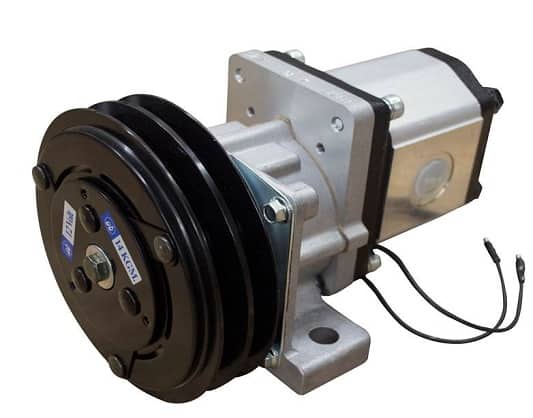 Clutch pumps are often utilized when a transmission output port is missing or inaccessible. Typical uses of these pumps are hay spikes, cranes and aerial bucket trucks, etc. Generally, when the pump output flow exceeds 15 GPM, the engine belt will slip under heavy load, and the clutch pump cannot be used in such conditions.
Advantages of Clutch Hydraulic Pump
- Belt driven
- A clutch pump is a small displacement pump
- These pumps can use for hay spikes and wrecker applications
- It doesn’t need adjustment
11) PTO Hydraulic Pump
It is a gear-type pump that uses for heavy-duty applications. It designs for PTO drive applications on all kinds of tractors. PTO hydraulic pump doesn’t require additional gearing.
It has a high-performance aluminum housing and minimal gear play and an end plate that is made of cast iron. The inner splined shaft runs through and is maintained on both ends by roller bearings.

Advantages of PTO Hydraulic pump
- PTO hydraulic pump has a self-adjusting wear plate
- There are very rare cases of leakage
- It has the least gear clearance
- It has a casing that is made of high-tensile aluminum
- This pump doesn’t need any extra gearing
Hydraulic Pump Maintenance
The necessity of hydraulic preventive maintenance can determine with time according to the working conditions of the equipment. If you want to maintain your hydraulic pump then follow the following steps:
- Inspect the level of oil in the oil tank of the power supply unit.
- Check the changes in oil temperature.
- Open your pump and check it for oil contamination.
- Inspect it for any possible leakage. If there is any leakage, then stop it.
- Check the pipe clamps and screws and tighten them.
- Monitor the pressure level on the pressure relief valve
- Inspect the noise of the hydraulic oil pump and the motor for changes. If the pump is generating loud noise compared to before, this high noise may indicate a problem. Try to contact the technician to identify and fix the problem.
- Before the inspection, check the valve block for leaks.
- Keep the surface of oil tanks, components, and pipes clean.
- Contact the technician to determine if maintenance is needed.
- Read the manufacturer’s instructions book to check if the manufacturer explained any problem.
Applications of Hydraulic Pump
- The hydraulic pump uses in automobile industries for different vehicles, such as it uses in the power steering system of the car.
- Hydraulic pumps are used for applications such as mining hardware, dump trucks, graders, ranger service devices, vacuum trucks, farm vehicles, loaders, cranes and excavators, etc.
- These pumps also use for applications such as slitters, steel plants, foundries, bed jacks, forklifts, blenders, lifts, transports, material dealing with, squeezes, and Infusion shaping machines.
FAQ Section
What is a Hydraulic System?
A hydraulic system is a transmission technology that uses fluid to transfer energy from an electric motor to an actuator such as a hydraulic cylinder. This fluid is incompressible, and the path of the fluid is as flexible as the wire.
These systems are mainly used when high power densities are required or when the demand for loads increases quickly. The hydraulic system is especially applicable to all types of moveable equipment (e.g., excavators) and industrial systems (e.g., presses).
In a wind turbine, the hydraulic system is employed to control the slope and the brakes. In some cases, various auxiliary structures (such as cranes and hatches) are also operated with the help of a hydraulic system.
What are the 4 types of hydraulic pump?
The major four types of the hydraulic pump are:
- Rotary Vane pump
- Gear Pump
- Lobe Pump
- Screw Gear Pump
Where are hydraulic pump used?
Hydraulic pumps use for different applications such as loaders, mining hardware, dump trucks, vacuum trucks, graders, farm vehicles, cranes, ranger service devices and excavators, etc.
Who invented the Hydraulic System?
Joseph Bramah invented the first hydraulic press in 1975.
Does a hydraulic pump create pressure?
A hydraulic pump generates movement of the fluid but it can’t create pressure.