Turbines are used all over the world for the production of electricity. The use of turbines is increasing day by day. There are multiple types of turbines that are designed according to the application requirements. A steam turbine is one of the most common types of turbines.
According to the working fluid, turbines have four major types:
- Water turbine
- Gas turbine
- Wind turbine
- Steam turbine
This article mainly explains the steam turbine working, types, components, and applications.
What is a Steam Turbine?
A steam turbine is a mechanical device that transforms the thermal power of steam into mechanical work in form of rotational energy. This turbine is known as a steam turbine because it uses steam as a working fluid.
In 1884, the first steam turbine was discovered by Sir Charles A. Parsons. Steam turbines are most commonly used to generate electricity in thermal power plants, as well as in various industrial applications that need mechanical power.
In this turbine, the mechanical work generates with the help of the turbine shaft. This shaft is coupled with the steam generator (as shown in the below diagram). The steam generator converts the turbine shaft’s mechanical power into electrical power.

The speed of the steam turbine is directly proportional to the output power. Therefore, the steam turbines must work at the highest speed if you want to achieve the highest output. The wheel turbines can’t rotate at high speed like a steam turbine.
These turbines have many advantages over other types of turbines such as steam turbines produce inexpensive electricity, and steam energy doesn’t pollute the environment.
Due to these reasons, these turbines use reciprocating engines as prime movers in large power plants. The steam turbines work on the basic principle of thermodynamics. Therefore, when the steam expands, its temperature drops.
Steam Turbine Working Principle
A steam turbine works on the basic principle of the Rankine cycle. The basic principle of a steam turbine involves the expansion of high-pressure steam through a series of stages, where it passes over sets of stationary and rotating blades.

Image source: schoolworkhelper
During the working of a steam turbine, first of all, water from an external source (such as a river, sea or canal) is transferred into the boiler section with the help of a pump. The boiler boils the water to a very high temperature so that water can convert it into supersaturated steam.
In the boiler, the rate of steam generation varies according to the combustion heat, flow rate, and the heat transfer surface area used. As the steam is produced, it is directed from the boiler to the turbine area. As the steam enters the turbine area, the pressure energy of the steam is transformed into K.E. by passing it via a nozzle.
As the steam strikes the rotor blades, it creates dynamic pressure on the shaft and rotor blades. Due to this reason, both the shaft and the blades start rotating in an identical direction. Due to this process, the steam’s thermal energy transforms into the rotational energy of the rotor blade, and the rotor starts rotating.
A shaft is coupled with the turbine rotor. The shaft receives rotational energy from the rotor and starts rotating.
A generator called a steam generator connects to the shaft via a coil. The shaft rotates the generator coil in a magnetic field. As the coil rotates in a magnetic field, electricity generates and flows inside the wires.
Due to the simple construction of steam turbines, the vibration is much lower than with other engines with the same speed.
Read Also: Working of Gas Turbine
Types of Steam Turbines
There are multiple types of steam turbines designed according to their different operations and their industrial importance. The types of steam turbines are given below:
1) Based on the point of steam entry
- Center admission turbine
- End admission turbine
2) Based on the application
- Marine turbine
- Industrial turbine
- Utility turbine
3) Based on the pressure of the turbine
- Low-pressure turbine
- Medium pressure turbine
- High-pressure turbine
4) Based on the exhaust condition of the turbine
- Extraction cum condensing turbine
- Extraction turbine
- Backpressure turbine
- Straight condensing
5) Based on the steam flow
- Radial flow turbine
- Axial flow turbine
6) Based on turbine blade design
1) Based on the Exhaust Condition of the Turbine
In this category, the steam turbine has the following three types:
i) Condensing Steam Turbines
In these types of steam turbines, steam enters the turbine by a control valve. The name of condensing turbine represents that the steam inside the turbine can’t expand because this turbine is for condensing purposes. Besides, the blade will get wet during the final phase.
The exhaust steam condenses in the condenser and the condenser transforms this steam into water. This condensed water is again used in the boiler to generate steam. These turbines are most common in hydroelectric power plants.

ii) Back Pressure Steam Turbine
In this turbine, the steam in the turbine doesn’t expand completely. After partial use of the steam thermal energy inside the turbine, all of the steam is released at a specific temperature and pressure.
The steam parameters at the discharge are determined according to the process requirements.

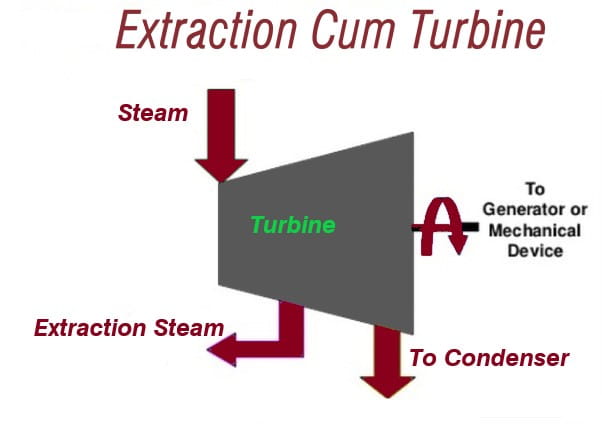
iii) Extraction Cum Condensing Turbine
The extraction cum condensing turbine has two inlet valves. The first stage of the turbine is known as the “High Pressure (HP) stage,” and the second stage is known as the “Low Pressure (LP) stage.”
As the HP phase completes, some steam is released. The remaining steam enters the LP stage, where it is condensed further at low pressure.
Read Also: Working of Turbofan Engine
2) Types According to Heat Drop Process
In this category, steam turbines have the following types:
i) Condensing turbine with generator
In this type of turbine, steam is sent to the condenser chamber at a pressure below than the atmospheric pressure.
In this turbine, the steam is discharged from the intermediate stage and used to heat the feed water. The exhaust steam’s latent heat during the condensation process is dropped completely.
ii) Condensed turbines with various intermediate extraction stages
In this steam turbine type, the steam is discharged from the intermediate phase and used for industrial heating applications.
iii) Back Pressure Turbines
In the back pressure turbine, the exhaust steam utilizes for heating or industrial applications. It is also possible to use a reduced vacuum turbine where the exhaust stream can be utilized for heating and processing applications. These turbines are also known as non-expanding turbines.
The turbine’s mechanical energy is utilized to operate mechanical or electrical devices such as compressors, fans, pumps, etc. These steam turbines have an easy configuration. They need very low or no cooling water.
These turbines have a low price as compared to extraction steam turbines. Back pressure steam turbine doesn’t reject heat during condensation; therefore, it has high efficiency.

iv) Topping Turbine
In the topping turbine, the exhaust steam is used in low-pressure and medium-pressure condensing turbines. The topping turbine work under higher initial steam temperature and pressure conditions. These turbines are used primarily to expand the capacity of power plants.

3) Types according to the steam conditions at the turbine inlet
The steam turbine has the following types in this category:
i) Supercritical Pressure Turbines
These turbines use steam with a pressure greater than 225 atm.

ii) Ultra-high Pressure Turbine
It uses a temperature of 550° C or more and a steam pressure of 170 atm or more.

iii) High-Pressure Turbine
It uses steam with pressures of more than 40 atm.
iv) Medium Pressure Turbine
These turbines consume up to 40 atm of steam pressure.
v) Low-Pressure Turbines
These types of steam turbines use steam with a pressure of 1.2 atm to 2 atm.
4) Types according to industrial use
According to the industrial applications, the steam turbine has the following types.
i) Stationary turbines with constant speed
These turbines are mainly used to drive alternators.
ii) Stationary turbine with variable speed
These turbines are used to power pumps, air circulators, turbofans, and more.
iii) Variable speed transient turbine
These turbines are typically used on railroad locomotives, ships, and steamers.
5) Types According to Blade Design
According to the design of blades, steam turbines divide into two main types.
- Reaction Turbine
- Impulse Turbine

i) Reaction Turbine
In the reaction turbine, the steam flows through the blades. Then, it expands on both the moving blades and fixed blades of the turbine. Moving and fixed blades have a continuous pressure drop.
Reaction turbines are a little bit dissimilar from impulse turbines, which consist of fixed nozzles and moving blades. As compared to impulse turbines, reaction turbines have a lower pressure drop per stage. A reaction turbine is generally more efficient.

An example of a reaction turbine is a Parson’s turbine. The reaction turbine requires twice as many rows of blades as the impulse turbine for the conversion of the same heat energy.
Read More: Read Turbine Working and Types
ii) Impulse Turbine
It is one of the most famous types of steam turbines. In the case of an impulse turbine, the steam exits the fixed nozzles at a very high speed and hits the fixed vanes around the rotor.
The blade deflects the steam flow deflection without changing the pressure. The shaft of the turbine rotates due to the changes in impulse.

In these turbines, steam which is injected at a very high speed from a fixed nozzle hits the blades attached to the rotor. The blade changes the path of the steam flow without varying the steam pressure.
The force generated by the change in torque causes the turbine shaft to rotate.
Read More: Impulse Turbine Working and Types
Components of a Steam Turbine
The steam turbine has the following major parts:
- Housing
- Rotor blades
- Rotor
- Governor
- Turning Gears
- Sentinel Valve
- Nozzle ring and reversing blade assembly
-
Labyrinth Seal
1) Housing
The housing bears all low-weight and high-weight operating loads. The rotor, blades, governor, and many other internal components are installed inside the turbine housing.
It designs in such a way that it minimizes the thermal load. It provides safety to all the internal parts of the steam turbine.
2) Rotor
The rotor has multiple buckets that rotate with the rotor’s movement. It has a shaft. One side of the shaft uses to connect the driven pump, and the other end of the shaft uses for the speed controller and the quick speed trip system.
It is a key part of a steam turbine that converts the thermal energy of the steam into mechanical power.
3) Blades
These blades use to extract the energy of the high-velocity steam and transfer it to the rotor. The design of these blades plays an important role in turbine efficiency.
4) Governor
The governor system is a speed-dependent control system that installs in a steam turbine. It is also known as a Controller. It uses to control the speed of the turbine.
A governor valve installs to control the turbine speed by changing the flow of steam by the turbine. It has a servo motor system, a counterweight with a spring return, and a steam valve.
This turbine component records the speed of the turbine shaft via a direct assembly or a magnetic pulse from the gear.
The variation in the outlet and inlet conditions of the steam turbine and changes in the power required from the pump cause changes in the speed of the turbine. This variation in speed causes the governor weights to be rearranged, followed by the governor valves.
5) Labyrinth seal
The labyrinth seal is a method to reduce leaks from the high-pressure side to the low-pressure side by permitting a small leak. The space between the shaft and the labyrinth is kept as small as feasible.
6) Nozzle ring and reversing blade assembly
The nozzle ring is installed to the lower inner half of the steam end casing. The nozzle installs inside the nozzle ring. It guides the steam from the steam chamber to the 1st row of blades in the Curtis stage. The Curtis stage contains two rows of blades.
The assembly of the reversing blade most commonly installs in between the Curtis stage blade rows. This assembly attaches to the nozzle ring. The main function of the reverse blade assembly is to reverse the flow of steam as the steam leaves the Curtis stage blades in the 1st row and directs the steam to the Curtis stage 2nd row blades.
7) Sentinel Valve
The sentinel valve works as a warning device. It installs on top of the turbine outlet end casing, which shows that the pressure in the turbine outlet end case is too high.
When the casing pressure becomes more than a certain level of operating pressure, the sentinel valve leaks a small amount of steam into the environment. During this leaking process, this valve produces an audible noise. You can’t use this valve as a safety valve.
8) Turning Gears
These gears are usually used in large turbines. This gear slowly turns the rotor during the heating and cooling process. This is to keep the rotor or shaft at a near-uniform temperature around the perimeter to maintain straightness and balance.
How to Calculate Steam Turbine Efficiency
A steam turbine has two different types:
- Impulse reaction turbine
- Reaction steam turbine
Both types of steam turbines work on different principles (as discussed above). Therefore, these have different efficiency, but the below-given formula can calculate the efficiencies of these turbines:

In the above-given equation, the input kinetic energy varies according to the absolute velocity of the steam at the turbine inlet. While the work done is dependent on many factors such as the steam’s relative velocity, reduction in the amount of steam heat in the turbine, the angle of the blade, and the guide vane’s angle at the turbine inlet.
In some cases, due to these factors, it is very hard to compute the work done, and sometimes it is impossible to precisely calculate some specific features such as steam pressure, temperature, and velocity.
The following are two various methods to calculate steam efficiency:
- Blade efficiency (ɳb)
- Stage efficiency (ɳs)
The steam velocity is used to calculate the blade efficiency (ɳb). In contrast, the variation in the steam enthalpy uses to calculate the stage efficiency (ɳs). The enthalpy describes the heat capacity of steam.
In both cases, the guide vane angle on the inlet side is indicated by α1, and it performs a vital function in turbine efficiency. The cosine of this angle performs a central function in determining the efficiency of the impulse and reaction steam turbines.
The below-given diagram represents the blade efficiency for the impulse and reaction turbines.

The above diagram is indicating clearly that an impulse turbine is less efficient than a reaction steam turbine.
The highest efficiency of the impulse turbine can be attained by setting the angle of the inlet blade at zero. This is because this angle minimizes friction by decreasing the blade’s surface area.
You can also connect multiple turbines in series to maximize steam energy before the steam is returned to the condenser. The stage efficiency computation technique works best in this type of turbine assembly.
Steam Turbine Efficiency Formula
The steam turbine efficiencies can be calculated by the following formulas:
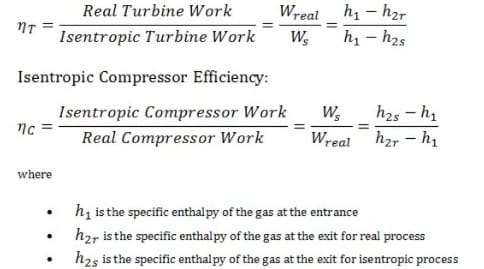
Isentropic Efficiency:- It is a ratio between the actual work and the Isentropic work of the turbine.
CHP Electrical Efficiency:- It is a ratio between the net electricity generated and the total fuel in the boiler. The following equation uses to calculate it:
CHP electrical efficiency = Net electricity generated/Total fuel into the boiler
Total CHP Efficiency:- It uses to measure the electricity and steam produced by the total fuel inside the boiler. Total CHP efficiency can be calculated by the following formula.
Total CHP efficiency = (Net steam to process + Net electricity generated)/Total fuel into the boiler
P-V Diagram of Steam Turbine
A steam turbine works on the base of the Rankine cycle. A Rankine cycle is an ideal thermodynamic cycle of a heat engine that transforms the heat energy into mechanical work while undergoing a phase change.
The P-V diagram of the steam turbine is given below:

- Isentropic compression: In the above diagram, line 1-2 represents the isentropic compression stage. In this cycle, the liquid pumps from low pressure to high pressure. During this process, the pump needs very low power for pumping liquid.
- Isobaric Heat Supply: Line 2-3 represents to isobaric heat supply process. The high-pressure water goes into the boiler, where it is heated via an external heat source at constant pressure to convert it into dry saturated steam.
- Isentropic expansion: Line 3-4 represents the isentropic expansion process. During this process, the dry saturated steam is expanded by the turbine to produce electricity. In this process, condensation occurs due to the reduction of pressure and temperature of the steam vapors.
- Isobaric heat rejection: Line 4-1 represents to Isobaric heat rejection process. During this process, the wet water vapors enter the condenser, where they condense to a saturated liquid at constant pressure.
Advantages and Disadvantages of Steam Turbine
The steam turbine has the following advantages and disadvantages:
Advantages of Steam Turbines
- They have a high thermal efficiency (i.e., 40%-60%)
- Steam turbines are designed for a wide range of power outputs, from small-scale applications to large-scale power plants generating hundreds or thousands of megawatts.
- They have long operational life and high reliability.
- They have the capability to use different fuel sources for steam generation.
- They environmental friendly.
- Steam turbines have smooth and quiet operation.
- They can be connected with renewable energy sources to produce cheap and environmentally friendly power.
- The electricity produced by a steam turbine has a relatively low cost.
Disadvantages of Steam Turbines
- It has a high initial cost.
- These turbines have a complex design.
- They require regular maintenance.
- They have multiple stages and blade configurations.
- The maintenance of these turbines is very hard.
- It has a longer start-up time as compared to a gas turbine and is longer than a reciprocating engine.
- The steam turbine needs a large installation space.
-
They are most efficient when working according to their capacity. When operating at part load, the efficiency of the turbine may reduce, making it less economical in situations where variable power output is needed.
Applications of Steam Turbines
- Electricity Generation: Steam turbines are most commonly used in thermal power plants for electricity production. In thermal power plants, nuclear energy or fossil fuel (oil, natural gas, or coal) is utilized to heat water and generate high-pressure steam that is used to drive the turbine and, in turn, electricity produces.
- Industrial Processes: They can be employed in different industrial applications that need mechanical power, such as in pulp and paper mills, chemical plants, and the oil and gas industry.
- Waste-to-Energy Plants: In the waste-to-energy plant, municipal solid waste is used to produce steam, which runs steam turbines to generate electricity. This process assists to lower the volume of waste going to landfills and produces renewable energy at the same time.
- Cogeneration (Combined Heat and Power, CHP): In cogeneration plants, they use to generate both useful heat and electricity for different processes or district heating systems.
- Geothermal Power Plants: Steam turbines are used in geothermal power plants, where steam is generated by utilizing the Earth’s natural heat.
- Solar Thermal Power Plants: Solar thermal power plants utilize a concentrated solar power (CSP) system to heat a liquid, which is then utilized to generate steam. The output steam is used to drive a turbine for electricity production.
- Biomass Power Plants: In the biomass power plant, these turbines are used to produce electricity. In this power plant, organic matters such as agricultural waste, wood, or dedicated energy crops are combusted to produce steam.
- Marine Propulsion: Steam turbines are employed in marine propulsion, mainly for large ships such as naval vessels and ocean liners.
Steam Turbine VS Steam Engine
The main difference between the steam turbine and the steam engine is given below:
| Steam Turbine | Steam Engine |
| Uses high-pressure steam to rotate a series of blades, converting thermal energy into rotational energy | Uses high-pressure steam to move a piston in a cylinder, converting thermal energy into reciprocating motion |
| Steam turbines are usually quieter | Steam engines generate extreme noise while operating due to the reciprocating motion of the piston and other parts. |
| It needs regular maintenance | It is easier to maintain because of simple design |
| It has multiple stages and blade configurations | It has fewer moving parts |
| It has ability to produce a large amount of power | It usually generates less power |
| These turbines have more complex design due to multiple stages and blade configurations | Steam engines have simpler design |
| They are used in large-scale power production plants | They are ideal for smaller-scale applications |
| It works at high speeds, usually in the range of thousands of RPM | It works at lower speeds, usually in the range of tens to hundreds of RPM |
| Steam turbine has higher efficiency (up to 40-60%) than steam engine because of the continuous expansion of steam and fewer energy losses | Steam engine has lower efficiency (normally about 10% to 20%) due to energy losses in transforming reciprocating motion to rotary motion |
| They are most commonly employed in large-scale power generation applications. | They are employed in ships, locomotives, and stationary engines for industrial applications |
FAQ Section
what change of energy occurs between the steam generator and the turbine?
Between the turbine and steam generator, thermal energy transforms into mechanical energy (rotational energy). Due to this rotational energy, the turbine rotor starts rotating, which further turns the coil of the generator, and the generator converts the mechanical energy into electrical energy.
The steam turbine works on which cycle
A steam turbine works on the base of the Rankine cycle.
Who invented the Steam Turbine?
In 1884, the first steam turbine was discovered by Sir Charles A. Parsons.
What are the parts of the Steam Turbine?
The steam turbine has the following types:
- Housing
- Labyrinth Seal
- Nozzle ring and reversing blade assembly
- Rotor
- Governor
- Turning Gears
- Sentinel Valve
- Rotor blades
What are the types of Steam Turbines?
Steam turbines have the following major types:
- Center admission turbine
- End admission turbine
- Marine turbine
- Industrial turbine
- Utility turbine
- Low-pressure turbine
- Medium pressure turbine
- High-pressure turbine
- Extraction cum condensing turbine
- Extraction turbine
- Backpressure turbine
- Straight condensing
- Radial flow turbine
- Axial flow turbine
- Reaction Turbines
- Impulse Turbines
What are the steam turbines used for?
Steam turbines are mainly used to generate electricity in thermal power plants, where they transform the thermal energy of the high-pressure steam into mechanical work and drive a generator to generate electricity. These are also used in the cogeneration system that produces both useful heat and electricity, as well as in different industrial processes demanding mechanical power, such as in the pulp and paper, chemical, and oil and gas industries.