The jackscrew or screw jack is one of the most common types of linear motion actuators used to lift or move loads. They can also be used for any application that requires linear motion or driven or dragged along the linear axis. Lead, ball, and cylindrical screws are simple mechanical actuators. This article explains the jackscrew working, types, and applications.
What is a Jackscrew?
A screw jack, also known as a jackscrew, works through the rotation of a leadscrew. Its primary applications include raising and lowering moderate to heavy loads, like vehicles, adjusting the horizontal stabilizers of aircraft, and serving as customizable supports for substantial loads, such as house foundations.
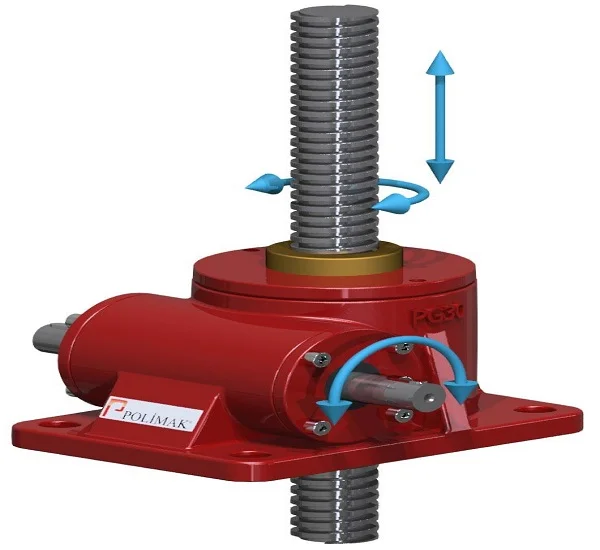
The most common jackscrew type is the traditional hand type, which is worked by applying force to the lever to lift the screw off the base of the unit, lifting the load, or lowering it. AC or DC motors are some familiar ways to drive jackscrew.
Construction of Jackscrew
A jackscrew contains a robust vertical screw equipped with a load platform fixed to its upper section. This screw is threaded into a fixed support frame characterized by a broad base that rests securely on the ground.
Positioned at the top of the screw is a rotating collar featuring a hole where a metal bar, known as the handle, can be inserted.
As the handle rotates in a clockwise direction, the screw moves up from the base, lifting the load on the platform. To manage heavy loads, the screw usually has special threads called Acme threads.
Working of Jackscrew
A screw jack is a gearbox assembly (either worm gear or bevel gear) and a transmission product (roller screw, ball screw, or lead screw) which, through the use of a motor, is used to convert rotary into linear motion.
They can be used to push, pull, tension, lock, unlock, tilt, pivot, roll, slide, and lift or lower loads, anything from a few kilos to thousands of tonnes.

Screw jacks are essential components of automated machines. Safety and legislative concerns encourage automation of the handling and lifting of heavy loads, especially in regions where workplace and health and safety legislation have been developed.
Types of Jackscrews
The Jackscrew has the following types:
1) Translating Screw Jack
In the translating jackscrew, when the gear is rotated, the worm acts directly on the lead screw, and the lead screw moves linearly. If the lead screw end is not fixed, the lead screw is easy to rotate due to the friction among the threads.
2) Translating Key Screw Jack
As mentioned above, the lead screw is fixed, so it cannot rotate. This is necessary if the lead screw is not attached to the end of the load. Coded and uncoded screw transmissions are often used in applications where many screws are connected to the same load.
3) Rotating Screw Jack System
4x screw jack. Translate the lifting nuts. Clearance under the lower mounting level of the jack body is not required. When designing the lifting plate, however, it must be taken into account that the plate can move over or past the lifting screw.
The translation speed of a screw jack is influenced by the number of times the screw spindle is started.
With single-start screw jacks, the system is normally self-locking because the friction angle of the threads is greater than the helix angle. i.e., an axial force exerted on the screw does not result in rotation. This is not the case with a multi-start screw because the angle of friction may be less than the angle of lead.
4) Translating Screw Jack System
6x ratio screw jack system. The lead screw connects to the normal load end. The clearance is required for the mounting body at the bottom of the screw jack to adjust the screw cover.
5) Rotating Screw Jack
The lead screw is mounted on the worm gear; then, the worm gear is engaged by the rotation of the lead screw so that when the load is placed in the nut, the nut slides with the lead screw.
Advantages of Electro-mechanical Over Hydraulic Jackscrew
- Work safety improvements, in case of power failure, the self-locking screwdriver can be hardened.
- The more energy-efficient mechanisms
- Machines with higher operating accuracy
- They require less maintenance
- They require less intervention to process frames
- Increased driving range with variable positioning
- Intense and regular application of force
- Cleaner machinery
Advantages of Jackscrews
One of the major advantages of a jackscrew compared to certain other jack types is its self-locking feature. Due to this feature, once you stop turning the screw, it locks and doesn’t move, no matter how much weight it’s holding.
This inherent stability of the jackscrews makes them safer compared to hydraulic jacks, which can move backward if the hydraulic pressure is unintentionally released while under load.
Disadvantages of Jackscrews
- The lifting capacity of the jackscrew is limited.
- Increase in the load as the friction of the threads increases.
- Fine threading will increase the usefulness of the screw but will also reduce the working speed.
- Using the longer handle will quickly reach the point where the inside end of the handle is bent.
- Jacks are now largely replaced by hydraulic jacks.
Applications of Jackscrew
- Vehicle Maintenance: Jackscrews are most commonly used for vehicle maintenance jobs. They are usually utilized to lift vehicles to perform different jobs such as vacuum leak repairs, oil changes, or tire changes.
- Automated Systems: They are used in different robotics and automated systems to regulate the position and motion of tools and components with precision.
- Industrial Machinery: They are used in different industries to lift heavy equipment and machines.
- Aircraft Maintenance: Jackscrews are also used to repair and maintain the horizontal stabilizers of aircraft.
- Construction: They are used in construction for adjusting and supporting the structures.
- Material Handling: Jackscrews are used in different material handling machines, such as conveyor systems forklifts.
- Stage and Event Production: They use to lift and position theater productions, lighting rigs, and heavy stage equipment.
- Medical Equipment: They also use in different medical equipment, like patient lifts and adjustable beds.
FAQ Section
What is the function of a Jackscrew?
A jackscrew, or screw jack, is a type of jack that is operated by turning a leadscrew. It is commonly used to lift moderate and heavy weights, such as vehicles; to raise and lower the horizontal stabilizers of aircraft; and as adjustable support for heavy loads, such as the foundations of houses.
What are the Parts of a Jackscrew?
- Screw Shaft
- Load Platform
- Support Base
- Rotating Collar
- Handle or Operating Mechanism
- Safety Features
- Threaded Hole
- Bearings or Bushings