A gate valve is the most famous and common type of valve. This type of valve also knows as the sluice valve. A gate valve controls the flow of fluids by raising (opening) and lowering (closing) the disc or gate. This article explains the gate valve working, parts, and applications.
What is a Gate Valve?
A gate valve is a type of valve that uses a gate or disc to control the fluid flow (usually gases or liquids) through a pipe or other conduit.
Gate valves operate by lowering or raising the wedge-shaped disc or gate, which either permits or blocks the fluid flow.
This is a linear motion valve that is used to stop or start the flow of fluids. These types of valves are employed for fully closed or fully opened services. Gate valves can’t be employed for flow regulation or throttling purposes.
A Sluice valve or gate valve is a general-purpose valve that works based on the opening and closing of a disc. Since this valve disc is similar to a gate that is installed perpendicular to the fluid flow path.
These valves can’t be employed for fluid regulation applications because the valve disc may damage if it is partially opened or closed. The high-velocity flow of the fluids in the partially open valves can create erosion on the surfaces of the disc and seat which may also lead to noise and vibration.

A gate valve uses when the liquid or gas flow needs to be straightened with the lowest limits. The gate valves can be installed in almost all directions because they have a bidirectional sealing function.
Gate valves are most usually used in different industrial applications, such as power generation, petrochemicals, oil and gas, wastewater treatment, and water supply.
Working of Gate Valve
A Sluice valve is one of the famous types of multi-turn valves that has a rising stem. This stem takes many turns to fully close or open the valve. It is generally used in the fully open or fully shut down condition; therefore, the flow regulation rate cannot be adjusted.

To open the valve, rotate the handwheel in the anti-clockwise direction, while when the valve needs to be closed, then rotate it clockwise. The rotation of the handwheel helps the gate to move upward or downward along the stem using the threaded mechanism. More than one full 360° turn is needed to completely close or open the gate valve.
When the gate moves upward, it helps to open the inlet to the outlet, providing a clear path for the fluid to pass through. Conversely, when the gate moves downward and sits on the valve seat, it shuts off the flow of the fluid.
The correlation between the vertical movement of the gate and the flow rate in a gate valve is not linear, with the most significant changes happening close to full closure.
When gate valves are used to regulate the fluid flow, the high flow velocity at partially opened positions can lead to wear on the gate and seat, as well as potential vibrations. This wear and vibration may reduce the life of the valve.
Construction of Gate Valve
Gate valves are usually made of alloy steel, steel, bronze, cast carbon, Aluminum, bronze, cast iron, etc. It has flanged ends. The bonnet is made of cast iron.

The gate valve has a disc or a gate attached to a spindle that acts on the nut. The valve bonnet is selected based on the installation requirements and the valve position. The valve bonnet can be union, bolted, or screwed-in type.
The screw-in type bonnet provides a permanent pressure seal. Union bonnets are usually employed in services that require proper cleaning and inspection. Bolted bonnets are employed for high-pressure services. The pressure-sealed bonnet is another type of valve bonnet that also uses for high-pressure purposes.
Types of Gate Valves
The gate valve has the following types:
- Rising stem valve
- Non-rising stem valve
- Knife valve
- Flexible wedge valve
- Wedge gate valve
- Parallel slide gate valve
- Solid wedge gate valve
- Slab Valve
1) Rising Stem Valve
The gate valves are available with a non-rising or rising stem. Large gate valves generally have a non-rising stem. This design permits an easy visual indication of the valve’s position but it needs more space for operation.

As the handwheel is turned, the valve stem is lifted off the bonnet by the handwheel. The disc position indicates by the disc, which also indicates whether the valve is in a closed or opened position.
2) Non-rising Gate Valve
Certain types of gate valves feature a non-rising stem, which means that the stem doesn’t extend out of the valve body when the valve is operated. Instead, the gate moves upwards along the stem within the valve.

This type of valve is particularly useful for applications where there is limited space for the stem to protrude from the valve body.
3) Knife Valve
It contains a thin, sharp-edged gate that may cut through and isolate solid-laden or viscous media, including powders or slurries. The design of the knife valve minimizes contact between different valve components. So, knife valve design reduces wear and tear between its various parts.

Knife valves possess specific features that make them suitable for certain applications. For instance, they eliminate sliding contact between the valve body and gate, allowing any built-up media to be flushed from the valve’s interior. Furthermore, these valves operate with a non-sliding motion. The valve’s sharp bottom edge can achieve a tight shut-off even when solid particles accumulate at the valve body’s bottom.
These gate valves are one-way valve that has the function of cutting off the flowing fluid. If there is any material present in the seating area, it will drain to ensure a proper close.
They have the ability to handle abrasive slurries and high temperatures, making them well-suited for use in industries such as chemical processing, power generation, and mining.
4) Flexible Wedge Valve
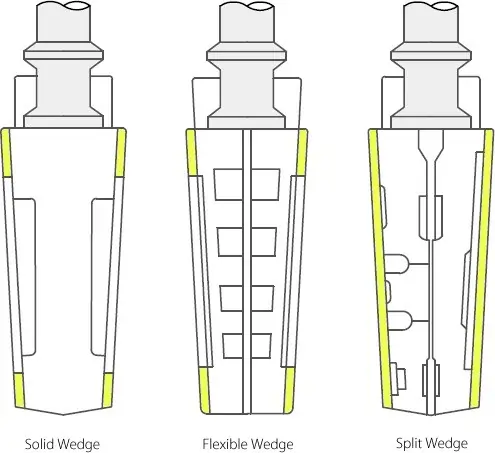
These valves have a solid disc with a cut around the boundary. This cut has a different depth, shape, and size. A narrow, flat cut around the wedge boundary reduces flexibility but maintains strength. Broader and deeper cuts around cast grooves or wedges provide greater flexibility but compromise strength.
Flexible wedge gate valves enhance seat alignment, providing improved leak tightness and performance, particularly in scenarios where thermal binding may occur. They are commonly utilized in steam systems.
Thermal expansion in steam lines may also cause valve body distortion, leading to thermal binding. The flexible gate design accommodates this expansion by allowing the gate to be flexed as the valve seat is compressed because of the steam pipeline’s thermal expansion, thereby preventing thermal binding.
However, a drawback of flexible gate valves is their tendency to accumulate line fluid in the disc, which can lead to corrosion and, eventually, a weakened disc.
5) Wedge Gate Valve
In wedge gate valves, the valve is closed by pushing the wedge downward towards the equivalent taper in the valve body. A perfect seal is achieved by aligning the body seat ring and the wedge.
If the valve is fully opened, the stem backseats into the bonnet bushing. However, for actuator valves, the stem is prevented from fully back seating to prevent causing damage. These types of valves reach complete closure through torque limitation, while the full opening is achieved by a travel limitation.
6) Parallel Slide Gate Valve
This valve doesn’t rely on a wedge to achieve proper seating. Instead, it is closed by two discs that are held together by a disc carrier and spring. This spring travels downward in parallel to seal the valve.
Once the body port is properly blocked, the stem stopper prevents the disc from moving more. As the valve is opened, the disc travels upward and the valve stem sits back. Typically, these valves reach full opening and closure through travel limitations.

Parallel slide gate valves are particularly suitable for high-pressure and high-temperature applications.
7) Solid Wedge Gate Valve
The solid wedge valve is one of the most commonly used types of gate valves. This valve contains a solid, single-piece wedge-shaped gate that fits snugly between the two seats of the valve and ensures a tight seal.
8) Slab Gate Valve
It is also known as a through-conduit gate valve. It consists of a single-unit gate featuring a bore-sized hole.

When the valve is opened, the bore aligns with both seat rings, facilitating a smooth flow with the lowest turbulence. This design results in reduced pressure loss within the system, making it ideal for transporting NGLs and crude oil.
While the valve seats remain clean but the disc cavity may trap external contaminants. To address this, a built-in plug is usually incorporated into the cavity, allowing for easy maintenance and draining of accumulated debris.
Applications of Gate Valves
- Water and wastewater treatment plants: Gate valves are most commonly used in water treatment plants to control the water flow by different pipelines. These valves also control the filling and emptying of the storage tank.
- Mining industries: They use to handle the flow of slurry, water, and other fluids in mining operations.
- Power generation: Gate valves are most commonly employed in power plants to regulate the water, steam, and other liquids flow. These valves are usually used in the steam distribution, cooling water, and boiler feedwater.
- Chemical and petrochemical industries: These valves help to control different chemicals and petrochemicals in chemical plants.
- Oil and gas industry: These valves are employed in the oil and gas industries to control the flow of natural gas, crude oil, and other petroleum products in storage tanks and pipelines.
- Marine industries: Gate valves are employed in marine applications to control the fuel, water, and other liquids on ships and in offshore facilities.
- Food and beverage industries: In the food and beverage industry, gate valves help to regulate the flow of different fluids, including dairy products, juices, and water.
- Fuel Transfer Systems: These valves are often employed in fuel transfer systems, fire protection systems, and ballast water systems.
- HVAC systems: Gate valves are utilized in HVAC systems to control the steam, water, and other fluids in heating and cooling areas.
- Agriculture: They are employed in the irrigation and agricultural systems to control the water flow through storage facilities, distribution networks, and canals.
Advantages of Gate Valves
- It has very low-pressure loss during operation.
- Mostly, it can use as a bi-directional valve.
- It is best appropriate for high temperatures and pressure applications.
- Gate valves are more affordable than other valve types.
- You can use them to control different types of fluids, such as chemicals, gas, steam, oil, and water.
- They have relatively simple design and operation.
- They have minimal pressure drop.
Disadvantages of Gate Valves
- It can’t be closed or opened fast like a globe valve.
- These valves require a large area for maintenance, operation, and installation.
- The gate valve requires high torque because of the high-pressure variance across the seats.
- They are prone to sediment buildup of solid particles in the valve bottom, which can interfere with the proper seating of the gate and cause leakage.
- These valves have a slow operation.
- The sluice valve produces high noise and vibration when it opens partially.
- These valves are not best for throttling.
- Grinding and lapping repair of these valves is tough to achieve.
Difference between Gate Valve and Globe Valve
|
Globe Valve |
Gate Valve |
| It uses to regulate, start or close the flow of different fluids. | It also uses to open or close the fluid flow but it can’t use for the regulation of fluids. |
| These valves can’t install in different directions. | These valves can install in different directions. |
| A globe valve has high cost than a gate valve. | It has low cost than globe valves. |
| These valves have a high-pressure drop. | These valves fairly have low-pressure loss as compared to globe valves. |
| They provide a good seal. | They can’t provide a better seal than globe valves. |
| Globe valves have a fast operation than gate valves. | Gates valves have a slow operation than globe valves. |
| These valves have a shorter stroke. | These valves have a longer stroke. |
Gate Valve Symbol
The symbol of the gate valve looks like the outline of a bowtie with 2 straight lines crossing each other to make an “X”. Then two vertical lines link the ends to make an enclosed shape.

FAQ Section
What are the parts of the gate valve?
- Handwheel
- Stem
- Packing rings
- Bonnet
- Gland
- Gland packing
- Gland bolts
- Yoke sleeve
- Body
- Gate
- Gate seats
What is the difference between a gate valve and a ball valve?
A ball valve and a gate valve are both types of valves used to control the flow of fluids, but they have different working methods and designs. A gate valve has a sliding gate that rotates upward and downward to control the fluid flow. A ball valve has a spherical ball that has a hole in its center that moves to close or open the fluid flow.
What are the gate valves used for?
Gate valves are most commonly used for on-off control of the flow of fluid in different systems and pipelines. These valves are best suitable for applications where a straight-line fluid flow with minimal pressure loss is required. Gate valves are most commonly used in gas, oil, and water pipelines, as well as in many other residential, commercial, and industrial applications.
What is more reliable a ball valve or gate valve?
The ball valves are considered more reliable compared to gate valves because of their fast quarter-turn operation, simpler design, and tight shutoff capabilities. These valves are less prone to leakage and need less maintenance.
When not to use a gate valve?
Gate valves are not ideal for regulating flow or pressure, nor for functioning in a partially open state. In such situations, a plug valve or a control valve would be a more suitable choice.